Evita
This new adaptation is the show of the summer, with heat radiating off the stage with each number performed, the fire of its force will burn far beyond its limited 12 week run.
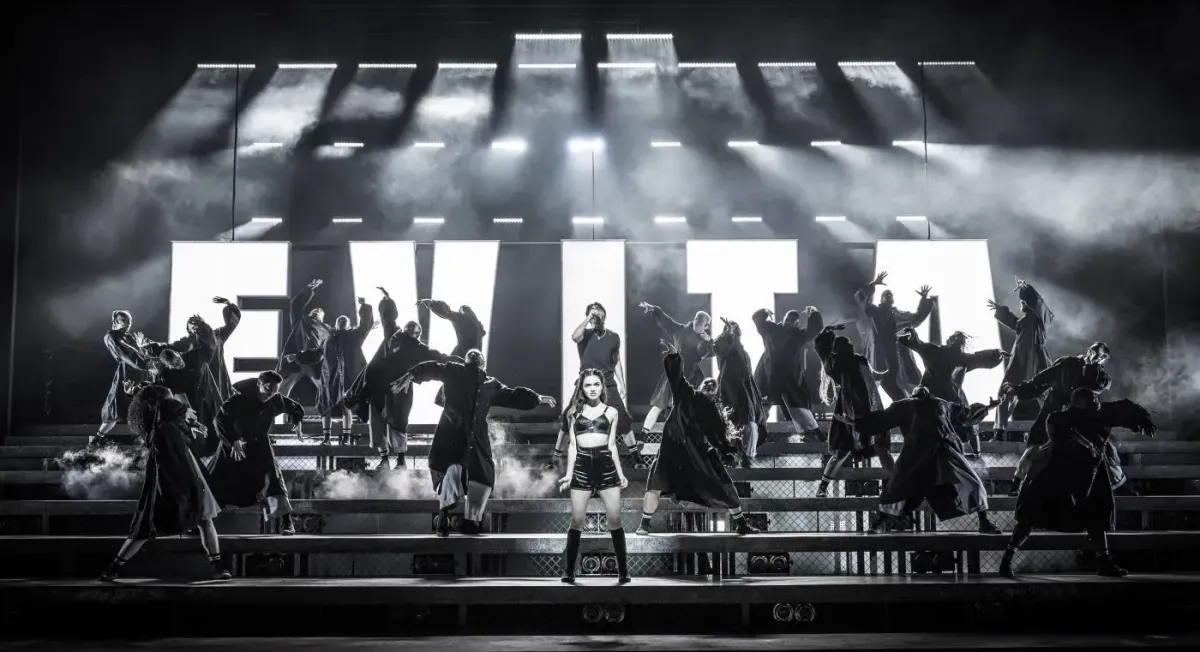
Jamie Lloyd’s production of “Evita”, originally by Andrew Lloyd Webber (ALW) and Tim Rice, has been given a revamp after being previously depicted on both stage and screen. The infamous titular character based on Argentinian figure “Eva Peron” has been played by some of the biggest names in music, including Elaine Paige (West End), Patti LuPone (Broadway), and Madonna (film adaptation). This new adaptation is the show of the summer, with heat radiating off the stage with each number performed, the fire of its force will burn far beyond its limited 12 week run.
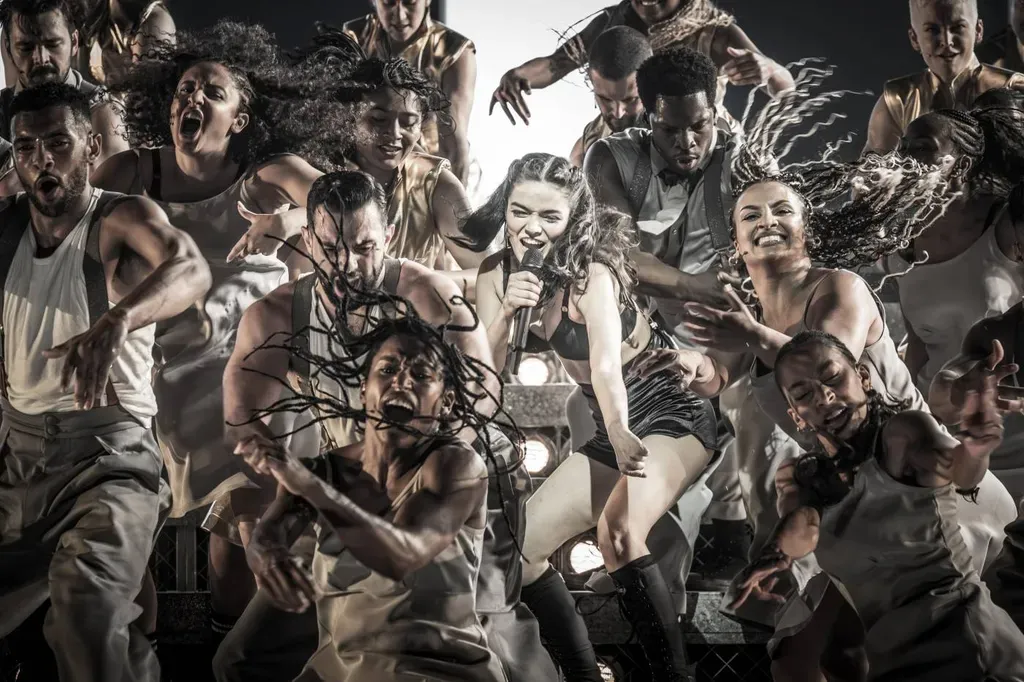
The staging of Lloyd’s production was not unexpected due to various promotional activity, with similar methods being used in his recent revival of another underrated ALW musical, Sunset Boulevard (2023). Due to the way many ALW musicals are rooted in storytelling, and the songs carry all of the dialogue and plot rather than prose, Lloyd’s choice of his signature staging style was appropriate for the show.
With minimal costumes and only a set of stairs on stage, the appearance at first glance is bare. However, the re-telling takes the format of a classic Greek tragedy with a chorus of dancers using intricate movement alongside the ensemble of singers. The dancing is a stand out element, choreographed by Fabian Aloise in a way unlike any other. The dancers in Evita are the story, making up various ensembles, their dramatically modern moves accurately convey the story being told, highlighting the subtext we don’t see and the inner feelings of characters. It is the lynchpin of the narrative — a refreshingly unconventional choice which assists in the effective execution of a traditional tragedy. This choreography style contrasts, compliments, and compensates the minimalist set and costumes. It strips down theatre to the truest form of human expression, where the raw visual of watching real people tell the story through only their bodies and voices, is still able to evoke emotion from an audience.
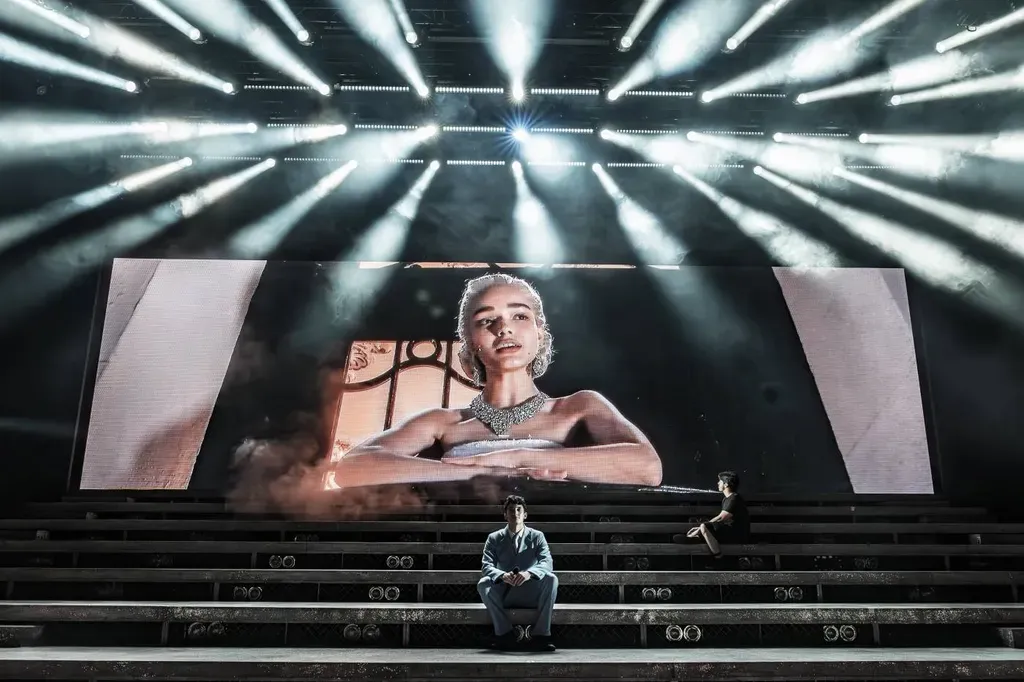
A most notable change to pervious productions of “Evita” is the traditional staging of the Act 2 opening ballad, which sees Rachel Zegler as Eva Peron singing outside the theatre. While the London Palladium has a vast crowd watching Zegler from above singing to them, the audience within the theatre sees it projected on a screen. It is a stroke of unconventional genius as it represents Evita herself was a figure who is “for the people”. As she is singing her love song to the “descamisados”, it is fitting that she is watching over those who did not pay to see her, they emulate the real people who would travel and wait eagerly to hear Eva Peron speak. Additionally, Eva Peron was first and foremost an actress, therefore it shows how much of her public show was a performance and how much resonated with her truthfully. The execution and experience is flawless, with no regret from the audience not seeing her sing the number on stage as her voice carries into the theatre effortlessly and video allows an intimate experience— far more so than those beneath her balcony, which further cements that Jamie Lloyd’s “Evita” supersedes musical status and instead transcends into a piece modern art.
The crown jewel of the show is undoubtedly Rachel Zegler, who shines as the central diamond that is Evita. To captivate a sold out audience of London’s theatre is a sensational feat. Although rarely leaving the stage, her energy never drops or falters, her energy remains supersonic throughout. She offers a new perspective to Eva, a portrayal which is more raw, allowing the audience to read more into every emotion. The amount of expression Zegler uses could be deemed by some as “over-acting”, however, it is understood to be a comparison to the most famous portrayal of the role, Madonna in the 1996 film adaptation, so it’s fair to say that Zegler’s emotional and expressive choices are not to be reprimanded, rather they are just a different variation of a classic character. A particularly thrilling moment from Zegler is her dazzling act 1 closing number “A New Argentina” which sends chills down the spine of every member of the audience, as she belts top notes with the most crisp diction and clearest tone. Her power and talent are truly unmatched, and she is the performer of a lifetime at only 24.
The casting is overall a triumph with Bella Brown handling the role of The Mistress with grace and flawless execution. Another notable performance is Aaron Lee Lambert as Agustin Magaldi, who fills the theatre with his song “On this Night of a Thousand Stars” which has minimal movement, leaving Lambert to carry with vocals alone and he succeeds beyond belief. Diego Andres Rodriguez who plays the narrator, “Che”, is notably phenomenal. He combines the angry grit of an angry and frustrated man with soothing dulcet tones. Rodriguez makes his west end debut in Evita and he shines as the audience feel the story and emotion through him. Similarly, James Olivas stars alongside Rachel as Eva’s colonel husband, eventually president of Argentina. He is exactly as Peron should be: tall, dark, handsome, and alluring but with a dry stiffness to him. Olivas sings the part with skill and in contrast to the large emotional expressions of Zegler and Rodriguez, gives a more nuanced performance, giving less away to the viewers — something the audience can only assume is a conscious choice to build on the narrative that he keeps his cards close to his chest. The only thing missing from the execution of the story from an audience perspective was the real life age difference between Eva and Juan Peron. Without this, some of the power dynamics of the original story are lost.
In summary, Lloyd steers away from the classic re-telling of a complex figure and for some that’s exactly what is needed and for others it may fall flat — but that is the beauty within the artistry of such a fresh and thrilling production in that it creates controversy, as Eva herself once did and still does both within her own right and through the daringly brilliant portrayal by Rachel Zegler. This production is five star worthy and will be cemented in theatre history.
Theatre: London Palladium
Reviewer: Faith Blackden
Date: 30/07/2025
Star: 5