Eat The Rich (Except Me Mates xx)
This is without question just the beginning for Franks, and with a Netflix deal on the horizon, her career matches her acrylics perfectly: sturdy, long, and glittering.

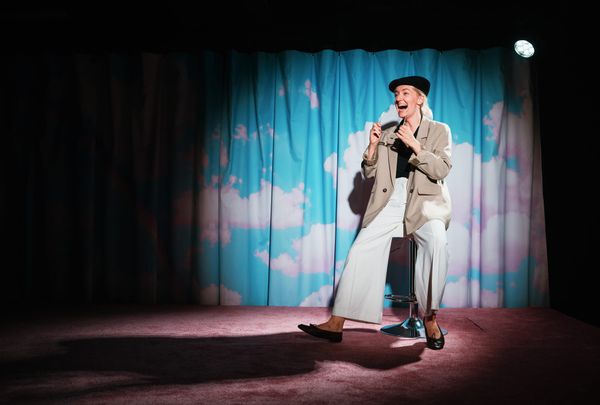
It is no secret that Jade Franks' one woman show Eat The Rich (Except Me Mates xx) has been a resounding hit since Edinburgh Fringe last year. A semi-autobiographical show that arrived at Soho Theatre's main stage trailing five star reviews and the kind of early career momentum most performers spend a decade chasing.
Franks enters dancing to club classics, immediately setting the tone, which is quietly punctured by the shrill ringing of a call centre phone. The push and pull is established from the off: the effortless joy she craves versus the brutal reality tying her down, and the class divide is laid out with precision, dismantling the common misconceptions about Liverpool and its people with wit and warmth before the story has barely begun.
Everything shifts when Franks is accepted into Cambridge. She arrives early and takes a cleaning job in the student rooms, a job that must stay secret not only because Oxbridge forbids paid work during study, but because she already knows that to these people, a cleaner is something to look straight through.
Franks fills her world with a cast of strong women: her fellow cleaner Christina, her call centre colleague, her tutor Sue, and her sister Laura, whose collective warmth runs as a quiet backbone through the show. At Cambridge she encounters Tizzy, Greg, Tilly and Hermes, characters who at times tip towards trope, though as Franks herself seems to acknowledge, a trope is a trope for a reason. Hermes in particular is a joy, the unapologetically gay, posh boy who takes Franks under his wing, his very expensive, most likely rare stuffed bird wing, and remains so entirely himself that you cannot help but love him for it.
Things unravel when Greg catches her cleaning his room and refers to Christina, without flinching, as "the help." He has no idea, of course, that the help includes his girlfriend. The moment marks the point at which she begins drifting further from herself, sharpened by flashforwards glimpsing a future where she is recognisably her and entirely unrecognisable at once, the accent softened, the long glittering acrylics swapped for short, natural nails. The affliction: becoming unrecognisable to the people who know her best.
The sharpest moment comes when Greg accuses Christina of stealing his thirty thousand pound watch, a scene carrying the quiet, ugly weight of every assumption ever made about a working class Eastern European woman in a room full of people who have never had to think about where they come from. Her eventual decision to vouch for Christina lands with a relief that surprises you with how much you needed it. The monologue that follows is the beating heart of the show. The dull, persistent ache of being looked at like you should feel grateful, like someone really did just take a chance on you, like belonging is a gift they are lending rather than a right you have earned. You can see it sitting raw in her face, the inequality, the injustice, the quiet and relentless erosion of classism that, despite the books and the plays and the films and the commentary, continues unchanged.
The show closes where it began, the opening lines repeated, this time from a stage in London. The full circle lands because she has earned it. Franks' writing is unflinchingly witty and palpably real, and that combination is rarer than it should be. This is without question just the beginning for Franks, and with a Netflix deal on the horizon, her career matches her acrylics perfectly: sturdy, long, and glittering.
Theatre: Soho Theatre
Reviewer: Lucy Frances
Date: 16/06/2026
Stars: 5